Practice
Baduanjin for Beginners: The Eight Sections of Brocade
A gentle introduction to the modern standing Baduanjin sequence, with eight plain-language steps, cultural background, natural breathing, and a comfortable range of motion.
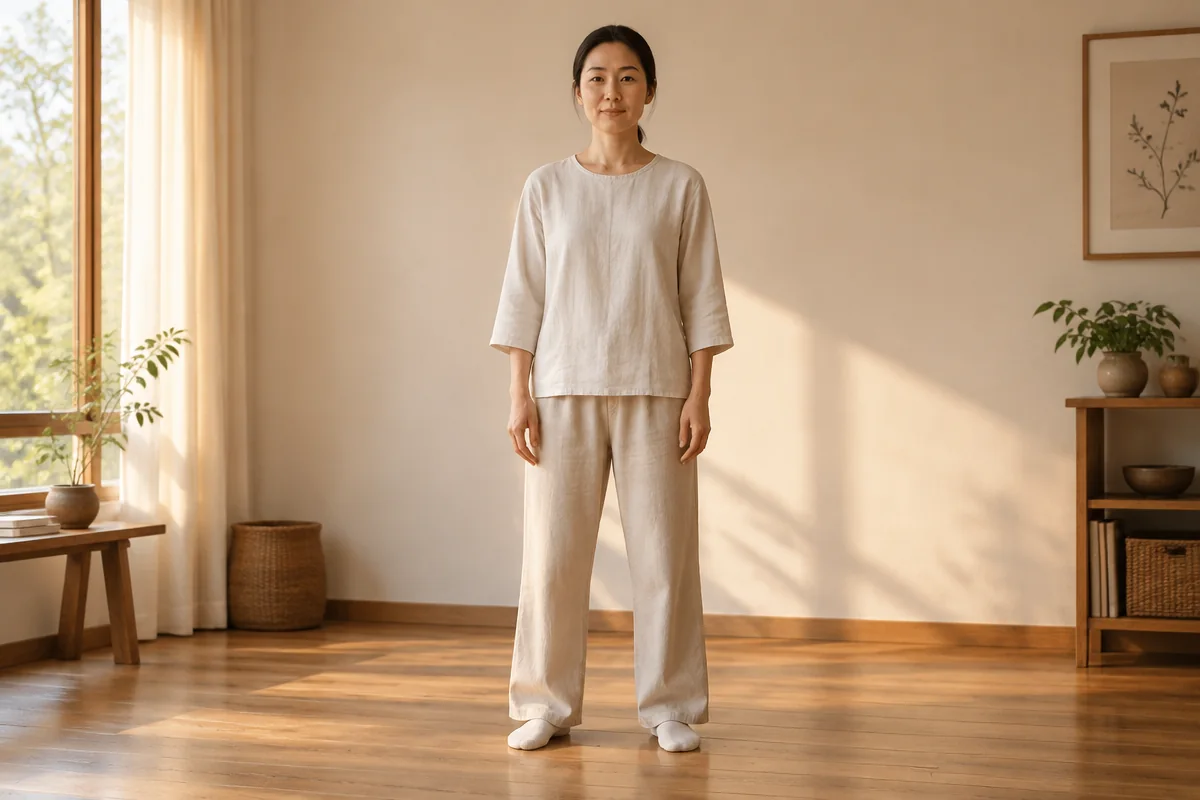
- 8 steps
- 12 minutes
- Gentle pace
Lift the Hands Overhead
Stand comfortably with your feet about shoulder-width apart and your knees easy. Cross your hands in front of your lower abdomen, then bring them up past your chest. Turn the palms upward and lift without forcing your shoulders toward your ears. After a brief, unstrained extension, lower your arms slowly out to the sides. Keep your torso tall and your breathing natural throughout.
Draw a Bow to Each Side
From a comfortable, higher stance, cross your hands in front of your chest. For the bow shape, extend one hand to the side while drawing the other hand back toward the opposite shoulder, and look gently toward the extended side. Return to the center and repeat on the other side. Bend your knees only slightly, keeping them aligned with your toes; there is no need to sink into a deep horse stance.
Raise One Hand and Press the Other Down
Stand tall with your arms relaxed. Raise one hand with the palm turning upward while the other hand presses gently downward beside your hip. Keep both elbows softly bent and lengthen through the arms without straining. Let the raised hand return along a comfortable path, then change sides. The movement is a mild vertical opposition between the two arms; keep your shoulders easy and avoid forcing the highest possible reach.
Turn the Head to Look Behind
Stand in an easy upright position. Rotate your arms gently outward while turning your head to look behind you to one side. Keep your torso facing forward rather than twisting your whole body. Return your head and arms to the center, then repeat to the other side. Use only a comfortable neck range and move slowly; do not pull the chin around or chase a larger angle.
Circle the Trunk and Hips
Take a wider stance only if it feels steady, and place your hands on your thighs above your knees. With a small knee bend, shift your weight slowly and guide your trunk through a small side arc, allowing your hips and head to follow smoothly. Return through the center and explore the other side. Keep the stance relatively high, shorten the arc as needed, and avoid whipping your head, forcing a backbend, or squatting deeply.
Reach Toward the Feet
Begin with a comfortable upward reach, then bring your hands down along either side of your back toward your hips. Fold forward only as far as feels easy, sliding your hands along the backs of your legs toward whatever point they reach. To come up, let your arms lead forward and upward while you unfold slowly. You may soften your knees. Do not bounce, pull on your legs, or make touching your feet the goal.
Slow Fist Punches with a Focused Gaze
Hold your hands in soft fists beside your waist. Slowly extend one fist forward to about shoulder height, then open the hand, turn the wrist gently, close the hand again, and draw it back. Repeat with the other arm, letting your gaze follow the moving hand without staring or straining your eyes. Keep your elbows relaxed and your grip moderate. Stay in a higher, comfortable stance rather than lowering into a deep squat.
Lift and Lower the Heels Gently
Stand upright with your feet comfortably placed and your body relaxed. Slowly lift both heels while keeping your weight steady over the fronts of your feet, then lower the heels gently to the floor. Use a small lift rather than chasing height, and do not land with a jolt. If balance is uncertain, rest a hand lightly on a stable chair, wall, or other secure support. Repeat only while the movement remains quiet and controlled.
Baduanjin, often translated as “Eight Sections of Brocade,” is a sequence of eight standing movements practiced as a form of qigong. This beginner guide presents the modern Health Qigong order in plain language. The emphasis is on learning the visible shapes at an unhurried pace, not on achieving a prescribed depth or a particular physical result.
The eight step cards above are a conservative introduction, not a reproduction of every detail in a full routine. They leave out forceful breathing, deep stances, and demands for maximum flexibility. A qualified instructor can provide the individual feedback and complete coaching that a written overview cannot.
What Baduanjin is
Qigong is a Chinese mind-body practice that can bring together movement, posture, breathing, and focused attention. Baduanjin is one named form within that broad family. The sequence can be practiced without special equipment. In this guide, attention stays on ordinary actions: where the hands travel, how weight shifts, and when to return to center.
The English card titles are descriptive editorial headings created for readability. They are not presented as official English translations. The order here follows the General Administration of Sport’s published Baduanjin sequence. A more detailed official-hosted PDF used for movement reference is explicitly a consultation draft, so this article does not call it a finalized 2026 standard.
A modern sequence with older roots
The standing Health Qigong sequence used here has a documented modern editorial history. China’s General Administration of Sport says that a project group was organized in late 2001 to collect Baduanjin versions from different periods and lineages, draw on their material, and rearrange the routine. The resulting Health Qigong Baduanjin book was published in July 2003.
That account supports calling this version a modern compilation with older roots. It does not support assigning the whole sequence to one ancient inventor or saying that today’s eight movements have remained unchanged for a thousand years. Keeping that distinction makes room for cultural continuity without turning a legend into a precise historical claim.
Before you begin
Choose a clear, level space and wear clothing that lets you move without restriction. Start with a small range and a higher stance. Move slowly and breathe naturally: there is no need to hold your breath or force each inhalation and exhalation to coincide with a particular arm movement. The 12-minute duration is a beginner pacing suggestion, not a universal timing standard.
Comfort sets the limit. Knees can stay softly bent, arms need not reach their highest point, and the sixth movement does not require touching the feet. Depth, pain, and extreme positions are not goals. You can pause, make a movement smaller, or return to a neutral stand at any point.
Stop if you develop pain, dizziness, chest discomfort, palpitations, unusual shortness of breath, or other significant discomfort; rest and seek medical advice when appropriate. If you have a recent injury or surgery, a health condition, pregnancy, or limited mobility, check with a qualified health or rehabilitation professional before practicing. A qualified instructor can also help identify suitable modifications.
What the traditional names mean
The historical Chinese names contain cultural and traditional Chinese medicine vocabulary, including sanjiao (often translated as “triple burner”), the spleen and stomach, “heart fire,” and kidneys. In this article, those phrases are naming history, not statements about what a movement does to an organ or a disease.
The plain English headings deliberately describe visible movement instead. “Raise One Hand and Press the Other Down,” for example, tells you what the arms do without converting the traditional name into a physiological promise. This distinction also explains why the cards do not use traditional organ terms as instructions or outcomes. Readers can encounter the older vocabulary as part of the form’s cultural identity while keeping the practical guidance concrete.
What research can and cannot say
Baduanjin has been studied in a range of settings, but studies differ in their methods, participants, and reporting. Those differences make broad, personal conclusions difficult. This guide therefore uses research to clarify uncertainty rather than to advertise a result.
A 2021 systematic review of Baduanjin safety included 47 trials with 3,877 participants. Twenty-two studies reported adverse-event monitoring protocols, and two reported occurrences of adverse events. The authors stated that insufficient adverse-event reporting limited the safety conclusions that could be drawn. Its literature search ended in October 2020, another reason not to treat it as a complete assessment for all later practice.
These figures are not a guarantee for an individual reader. The absence of reported serious adverse events in the included trials is not proof that significant discomfort is impossible. Paying attention to your own response and using appropriate professional guidance remain part of a cautious approach.
Keeping the practice ordinary
Baduanjin does not need to become a test of flexibility, endurance, or perfect recall. A short practice can simply be a way to learn a cultural sequence, notice transitions, and set aside a few quiet minutes. Some days may include all eight sections; on others, a careful pause after fewer movements may be the more comfortable choice.
The aim of this guide is familiarity rather than mastery. Use the written steps and looping demonstrations together to understand the general direction of each movement; you do not need to match an animation’s speed, depth, or repetitions. Keep the pace ordinary, and let complete instruction remain complete: a teacher can observe details that a page cannot. Nothing here should be used to postpone care for a medical concern.